Elevation Effects on Athletic Outputs Linking Soccer, Court Sports, and Equine Competitions in Layered Prediction Models
Amir Beck · Aug 11, 2026

Elevation Effects on Athletic Outputs Linking Soccer, Court Sports, and Equine Competitions in Layered Prediction Models
Altitude changes alter oxygen availability and physiological responses across multiple sports, and researchers have documented these shifts through controlled studies and field observations since the mid-20th century. Data from competitions held above 1500 meters show consistent patterns in endurance capacity, recovery intervals, and power output, while layered prediction models integrate these variables with environmental readings, athlete histories, and sport-specific metrics to refine performance forecasts.
Physiological Mechanisms at Different Elevations
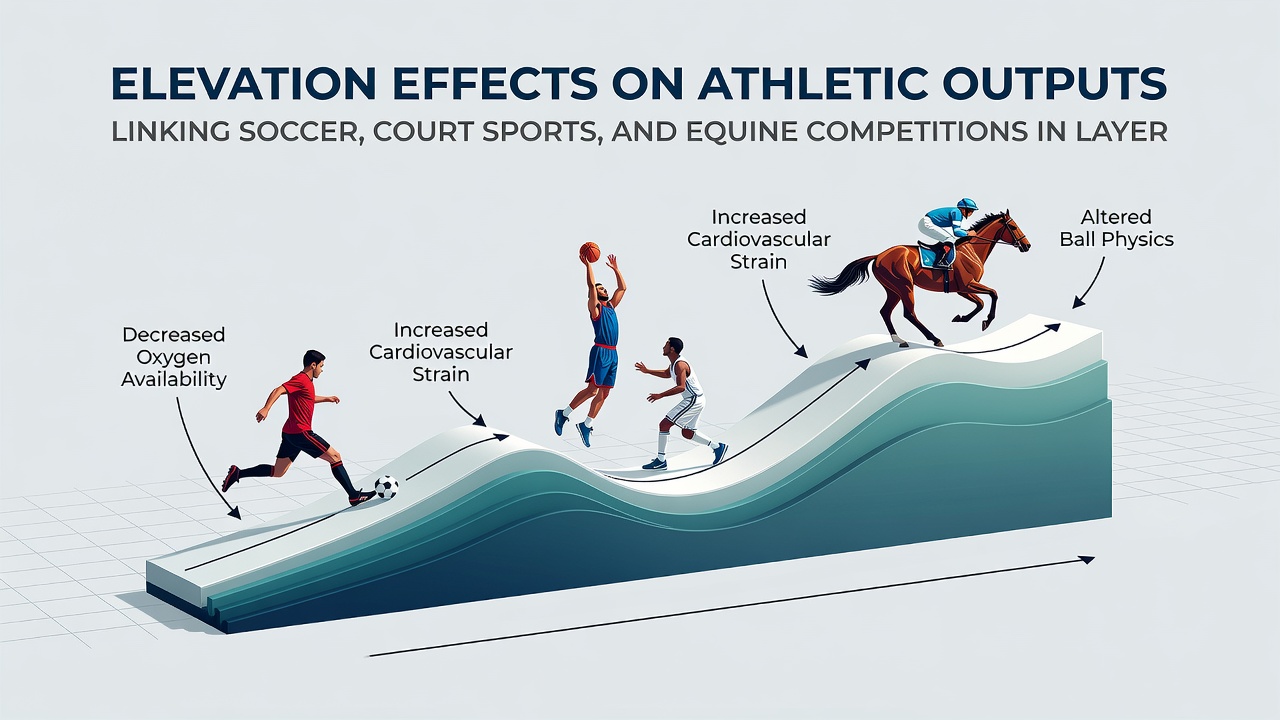
Lower partial pressure of oxygen at higher elevations reduces maximal oxygen uptake, a response measured in laboratory settings and verified during actual events, and this effect compounds over repeated efforts because muscle buffering capacity declines faster when arterial saturation drops. Studies conducted at moderate altitudes between 1500 and 2500 meters report average reductions in VO2 max ranging from 7 to 12 percent, with greater decrements observed beyond 3000 meters; the same research indicates that explosive movements lasting under 10 seconds experience smaller immediate losses because anaerobic pathways remain relatively intact during initial bursts.
Soccer Performance Under Altitude Stress
Soccer matches played at elevation feature measurable changes in total distance covered and high-intensity running volume, particularly in the second half when cumulative fatigue sets in, and match data from venues such as Mexico City demonstrate that teams traveling from sea level often record 5 to 8 percent less sprint distance after the 60-minute mark. Layered models incorporate pre-match acclimatization days, prior altitude exposure, and positional demands to adjust expected output curves, while also accounting for hydration status and heat load that frequently co-occur at these sites. Observers note that set-piece execution and decision-making speed remain closer to baseline levels because these actions rely less on sustained aerobic supply.
Court Sports and Short-Burst Dynamics
Court sports such as basketball and tennis exhibit different altitude signatures because rallies and possessions last seconds rather than minutes, yet repeated bouts still accumulate oxygen debt that surfaces in later quarters or sets, and performance tracking from tournaments staged at 1800 meters reveals modest increases in error rates on prolonged points alongside preserved peak serve and jump heights. Prediction frameworks layer court-surface friction coefficients with player recovery profiles and match duration to forecast point-win probabilities more accurately, and analysts cross-reference these outputs with heart-rate variability readings collected during acclimatization periods. What's interesting is that indoor facilities at elevation sometimes reduce the thermal gradient compared with outdoor soccer pitches, producing a secondary variable that models must weight separately.
Equine Responses and Racing Metrics
Horses competing at altitude display parallel declines in aerobic capacity, with studies on thoroughbreds and event horses showing reduced peak speeds over distances exceeding 1400 meters and altered stride frequencies during sustained efforts, while sprint races under 1000 meters maintain times closer to sea-level norms. Layered equine prediction systems combine blood lactate thresholds measured pre-race, historical performance at similar elevations, and track surface moisture content to generate adjusted pace figures, and data collected during August 2026 meetings at high-plains venues continue to refine these weighting factors. Jockey decision-making around early positioning also shifts because mounts tire earlier when oxygen delivery is limited, a pattern confirmed through video analysis and sectional timing.
Integration Within Layered Prediction Models
Modern forecasting architectures stack physiological, environmental, and historical datasets into sequential layers that update dynamically as new inputs arrive, and each layer applies altitude-specific correction coefficients derived from meta-analyses of multi-sport competitions. The first layer normalizes raw performance statistics for elevation, the second incorporates acclimatization timelines and individual response curves, and subsequent layers blend cross-sport correlations such as shared fatigue trajectories between soccer midfielders and endurance horses. Researchers at institutions including the Australian Institute of Sport have contributed validation datasets that allow models to test predictive accuracy across seasons, while the International Olympic Committee maintains open-access repositories that support further calibration of these frameworks. Models deployed ahead of August 2026 events continue to incorporate real-time barometric readings to adjust probabilities on an hourly basis.
Cross-Sport Data Linkages and Model Refinement
Because the underlying oxygen-delivery constraints operate similarly across species and movement types, analysts can transfer coefficient sets between soccer workload models and equine split-time projections with measured confidence intervals, and court-sport recovery indices supply additional validation points for short-burst decay functions. This interoperability reduces the data volume required to train new site-specific models and improves robustness when sample sizes at a given elevation remain limited. Organizations such as the U.S. Anti-Doping Agency have published supporting physiological benchmarks that further anchor these inter-sport linkages in objective measurements rather than anecdotal reports.
Conclusion
Elevation exerts measurable, sport-specific effects on athletic outputs that layered prediction models capture through sequential physiological and environmental adjustments, and continued collection of multi-sport performance data supports incremental improvements in forecast precision. As competitions scheduled for 2026 and beyond proceed at varied altitudes, these frameworks provide structured methods for translating elevation variables into consistent performance expectations across soccer, court sports, and equine events.