Algorithmic Pattern Recognition in Probability Matrices for Constructing High-Yield Event Combinations
Elena Long · Oct 16, 2026

Algorithmic Pattern Recognition in Probability Matrices for Constructing High-Yield Event Combinations
Researchers in data science and applied mathematics continue to refine techniques that apply algorithmic pattern recognition to probability matrices, structures that encode joint likelihoods across multiple variables or events, and these methods help identify subsets of combinations where collective probabilities exceed what isolated calculations predict. Studies from October 2026 highlight increased adoption of matrix-based approaches in sectors ranging from risk modeling to operational forecasting, because such frameworks allow systematic decomposition of complex interdependencies while computational tools extract recurring structures within the data.
Understanding Probability Matrices in Event Analysis
Probability matrices organize data so that each entry reflects the likelihood of simultaneous occurrence between pairs or groups of events, and analysts construct them from historical records, sensor outputs, or simulation runs. When these matrices grow large, direct inspection becomes impractical, which is why algorithms step in to detect latent patterns such as clusters of correlated entries or low-rank approximations that reveal dominant relationships. Techniques including singular value decomposition and non-negative matrix factorization reduce dimensionality while preserving key probabilistic information, allowing observers to isolate combinations whose joint yields stand out from background noise.
Evidence from multiple academic projects shows that pattern recognition pipelines often begin with preprocessing steps that normalize entries and remove sparse regions, after which clustering algorithms group similar rows or columns to surface candidate high-yield sets. Those who have examined real-world deployments note that the resulting combinations frequently align with domain-specific constraints, whether in supply-chain disruption scenarios or epidemiological spread models, because the matrix format naturally captures conditional dependencies that simpler pairwise tables overlook.
Core Algorithms Driving Pattern Detection
Machine learning frameworks apply supervised and unsupervised models to probability matrices in order to flag regions where event co-occurrence rates exceed baseline thresholds, and convolutional neural networks adapted for matrix inputs have demonstrated particular effectiveness at recognizing spatial or temporal motifs within the data. Researchers at institutions across North America and Europe have documented performance gains when these networks incorporate attention mechanisms that weigh distant matrix entries according to their contribution to overall yield. Meanwhile graph-based algorithms convert matrix entries into weighted edges, enabling community detection methods to isolate tightly connected event groups whose combined probabilities justify focused attention.
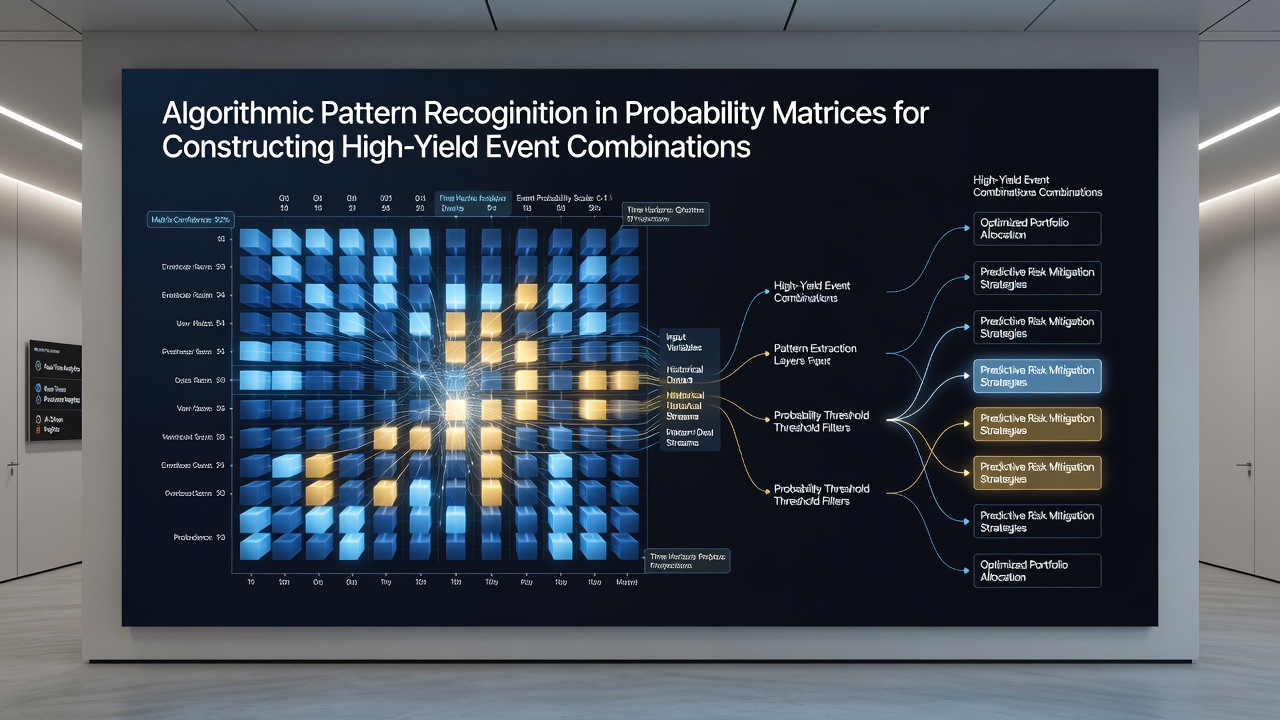
Reinforcement learning variants further optimize the search process by treating matrix traversal as a sequential decision task, where agents receive rewards proportional to the probabilistic yield of discovered combinations, and training data drawn from large-scale simulations accelerates convergence toward stable patterns. Reports issued by the National Institute of Standards and Technology outline evaluation protocols that compare algorithmic outputs against ground-truth matrices generated under controlled conditions, confirming that hybrid approaches blending factorization with deep learning deliver consistent improvements in recall and precision metrics.
Applications Across Domains and Recent Developments
Financial institutions apply these methods to construct scenario sets for stress testing, where probability matrices derived from market indicators help surface combinations of asset movements that produce outsized portfolio impacts, and logistics operators use similar matrices to anticipate sequences of delays whose joint effects compound beyond individual forecasts. In October 2026 several research consortia released updated benchmarks showing that pattern recognition systems operating on updated probability matrices reduced computation time by measurable margins compared with exhaustive enumeration techniques. Data from Statistics Canada indicates growing integration of these tools within national statistical frameworks, particularly where event combinations inform resource allocation decisions under uncertainty.
Observers tracking cross-industry adoption point out that open-source libraries now include dedicated modules for matrix pattern mining, lowering barriers for smaller organizations to experiment with the same algorithms previously limited to well-resourced labs. One documented case involved a European research team that adapted spectral clustering to identify high-yield meteorological event sequences, achieving alignment with independent verification datasets at rates exceeding earlier manual approaches. Such examples illustrate how algorithmic advances translate into practical workflows without requiring bespoke infrastructure.
Challenges in Implementation and Validation
Matrix sparsity remains a persistent obstacle because many real-world event probabilities sit near zero, which can mask meaningful patterns unless algorithms incorporate regularization or imputation steps, and validation procedures must therefore balance sensitivity to rare combinations against risks of overfitting to noise. Independent audits conducted by academic groups in Australia and the United States emphasize the importance of hold-out testing on temporally shifted data to confirm that recognized patterns generalize beyond training periods. Those who have studied deployment logs report that monitoring drift in matrix statistics over successive updates helps maintain reliability when underlying event distributions evolve.
Computational cost also scales with matrix size, prompting ongoing work on distributed implementations that partition large probability structures across clusters while preserving global pattern integrity, and early results from collaborative projects suggest that federated learning variants can achieve comparable detection performance with reduced data movement. Regulatory interest in transparent algorithmic decision-making has spurred development of explainability layers that map detected combinations back to specific matrix entries, satisfying requirements for auditability in sectors subject to external oversight.
Conclusion
Algorithmic pattern recognition applied to probability matrices supplies a structured route for locating high-yield event combinations across diverse application areas, and continued refinement of factorization, clustering, and learning-based methods supports expanding use cases as data volumes grow. Figures from multiple national agencies and research bodies confirm measurable progress in accuracy and efficiency, while remaining technical challenges around sparsity and validation continue to drive incremental improvements. The trajectory observed through late 2026 indicates sustained investment in these techniques as organizations seek reliable ways to navigate probabilistic complexity.